|
[News] KAIST Explores Solutions for African Youth Employment with World Bank and African Union (KAIST News, 2026.03.10.)
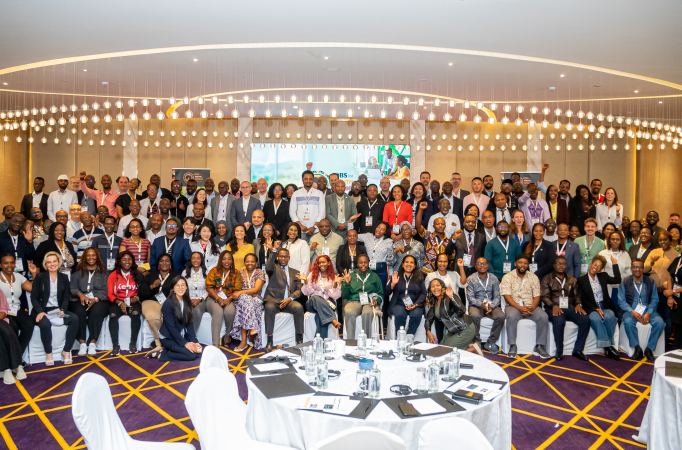
KAIST announced on the 6th that the 'Jobs for Youth in Africa Knowledge Exchange' platform was held in Nairobi, Kenya, from March 3 to 5 (local time). The event was hosted by the Kenyan government and co-organized by the World Bank Group, the African Union, and the KAIST Global Center for Development and Strategy (G-CODEs).
As a high-level policy implementation platform dedicated to addressing youth employment challenges in Africa, the event drew approximately 200 participants, including government officials from over 20 African nations, international organizations, the private sector, academia, and development cooperation partners. KAIST participated as a key global partner linking technology and policy, presenting innovation models for employment systems based on digital and Artificial Intelligence (AI) technologies.
< Scene from the meeting hosted by the Kenyan government >
With Africa’s youth population projected to double by 2050, the continent faces significant hurdles such as high unemployment rates and informal employment. This event marked the second face-to-face meeting of the 'Jobs for Youth in Africa Community of Practice (CoP),' which was launched in Kigali, Rwanda, in 2025. The meeting aimed to share policy experiences among member states and materialize scalable implementation models. Salim Mvurya, Kenya's Cabinet Secretary for Youth Affairs, Creative Economy, and Sports, attended the opening ceremony and emphasized that youth job creation is a critical priority at both national and continental levels.
The program focused on several key themes:
• Evidence-based youth employment strategies
• Innovation in employment systems through digital and AI technologies
• Improving labor market outcomes through Recognition of Prior Learning (RPL)
• Business environment reforms and strengthening value chain linkages
Notably, in the session titled "Digital and AI-based Employment System Innovation," Professor Kyung Ryul Park of KAIST shared Korea’s digital transformation experiences and AI application cases, proposing directions for data-driven policy design and the development of technology-based employment platforms. Additionally, KAIST Professor Ga-young Park facilitated mutual learning and connected cases of scalable youth employment projects across countries during the "Global Cafe Session."
Participants visited the project site of "National Youth Opportunities Towards Advancement (NYOTA)," an initiative pursued by the Kenyan government and the World Bank. There, they observed a comprehensive youth employment model that integrates vocational training, job matching, and entrepreneurship support. The site visit served as a practical learning opportunity to share the processes of policy design and execution.
Since last year, KAIST has been involved in digital innovation projects for youth employment in East Africa through the Korea-World Bank Partnership Facility (KWPF). Through this event, the university reaffirmed its status as a global cooperation hub leading technology-based policy innovation.
"The issue of youth employment is a structural challenge that combines digital transformation, industrial strategy, and educational reform," stated Professor Kyung Ryul Park. "KAIST will continue to present actionable policy models based on data and technology while strengthening international cooperation."
This Knowledge Exchange platform is evaluated as a significant milestone that reaffirmed the African youth employment agenda as a core priority of international cooperation and solidified the foundation for enhancing policy implementation capabilities. A follow-up workshop is scheduled to be held early next year at the Kenya Advanced Institute of Science and Technology (Kenya-AIST) campus in Konza, Nairobi, which is modeled after KAIST.
Go to the original article
|
|
[News] KAIST NYU Host AI Governance Summit in New York (KAIST News, 2026.02.09.)
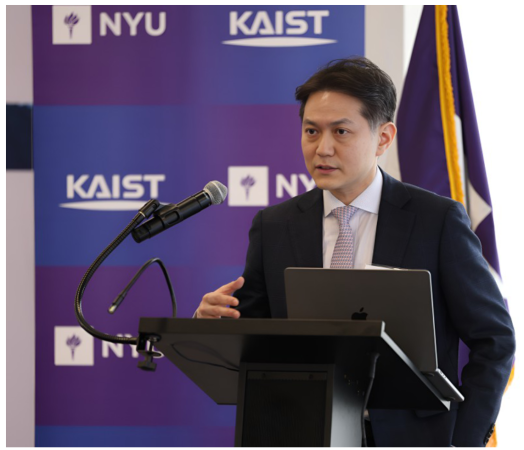
< KAIST Professor Kyung Ryul Park delivering a keynote speech >
KAIST announced on February 9th that the KAIST-NYU AI and Digital Governance Summit, co-hosted with New York University (NYU), was held at NYU in New York from February 6 to 7 (local time). Amid the rapidly expanding impact of Artificial Intelligence (AI) across society, this summit was designed to combine private consensus meetings with public discussions to seek practical AI governance solutions that harmonize technological innovation with safety and ethical responsibility.
The summit was attended by 60 global AI governance leaders representing academia, industry, and civil society, including NYU professors Matthew Liao and David Chalmers, Victoria Nash (Director of the Oxford Internet Institute), Professor Vincent Conitzer (Carnegie Mellon University), Iason Gabriel (Principal Scientist at Google DeepMind), and Philip Goldberg (former U.S. Ambassador to South Korea). In particular, the public discussion on the second day drew high interest, with approximately 450 audience members in attendance.
< Brad Carson, U.S. Representative for Responsible Innovation and former U.S. Congressman, delivering a keynote speech >
This event garnered attention as an 'experimental consensus model' aimed at deriving an actionable AI governance framework beyond a simple forum. KAIST’s Global Center for Open Development with Evidence-based Strategies (G-CODEs) and the NYU Center for Bioethics had formed three working groups—Governance Requirements, Institutional Architecture, and Implementation Pathways—since last December to conduct preliminary discussions. At the New York site, practice-oriented recommendations were derived through intensive consensus-style discussions and voting.
In the Governance Requirements session, the need for enhanced oversight and monitoring of high-risk AI systems was discussed. In the ‘Institutional Architecture’ session, principles for designing AI oversight bodies were reviewed, referencing existing high-risk technology oversight models such as the FDA, IRB, and FAA. In the Implementation Pathways session, short-term governance tools and corporate responsibility standards that could be applied even during the current gap in international regulation were addressed as key issues.
Major global Big Tech experts from Meta, Google DeepMind, IBM, Amazon, Anthropic, TikTok and Hugging Face participated in the summit. From KAIST, researchers including Prof. So Young Kim , Prof. Kyung Ryul Park, and Prof. Hyungjun Kim shared Korea’s research achievements in AI governance.his event was conducted with support from the Korea Foundation’s (KF) international collaborative research program.
Professor Kyung Ryul Park of KAIST stated, “This summit was a meaningful attempt to expand AI governance beyond technical regulation into a matter of international cooperation and institutional design. Through the cooperation between KAIST and NYU, we will build a foundation for Korea to lead global AI governance discussions.”
KAIST President Kwang Hyung Lee remarked, “The importance of governance discussions for responsible AI innovation is growing. KAIST will continue to lead interdisciplinary research and policy discussions in the field of AI governance through international partnerships.”
< Sebastien Krier, AI Policy Lead at Google DeepMind, speaking >
#ai governance #kaist nyu #ai #digital governance sumit
Go to the original article
|
|
[News] KAIST Proposes a Multinational AI Cooperation Strategy Beyond U.S.–China Dominance (KAIST News, 2026.01.19.)
“Intensifying geopolitical competition leaves AI bridge powers in a difficult situation where they’ll soon likely face insurmountable barriers to independent frontier AI development. To stay relevant and thrive economically, they need to work together and strategically choose their AI development approaches.” – Professor Yoshua Bengio, AI pioneer and co-author of the report.
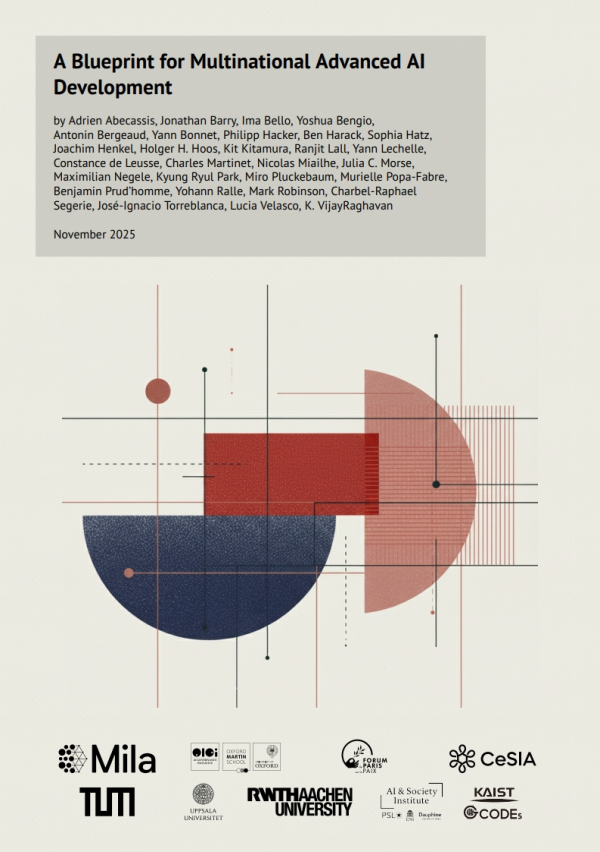
KAIST (President Kwang Hyung Lee) announced on January18th that a research team led by Professor Kyung Ryul Park from the Global Center for Development and Strategy (G-CODEs), in collaboration with Canada's Mila - Quebec AI Institute, Oxford University, RWTH Aachen University, and other global institutions, has co-published a policy report titled 「A Blueprint for Multinational Advanced AI Development」.
The report underscores that “an international advanced AI research & development partnership of AI bridge powers can feasibly produce frontier AI models, and is essential for safeguarding the sovereignty, democratic values, economic competitiveness and growth, technical innovation, and national security of these bridge power states.”
The report highlights that approximately 90% of global AI computing capacity is concentrated in the U.S. (75%) and China (15%). It analyzes that this concentration of resources could restrict "bridge power" nations from independently developing advanced AI and deepen technological dependence on specific countries or global Big Tech companies.
<(From top left) Professor Kyung Ryul Park (KAIST), Professor Yoshua Bengio (University of Montreal), Professor Holger Hoos (RWTH Aachen University), Professor Joachim Henkel (Technical University of Munich), Nicolas Miailhe (Co-founder of The Future Society), and Professor K. VijayRaghavan (National Centre for Biological Sciences, TIFR)>
According to the report, "AI Bridge Power Nations" refer to countries that, while not superpowers like the U.S. or China, possess world-class research influence and digital infrastructure, but face realistic constraints in building hyper-scale AI systems alone. South Korea, Canada, the UK, Germany, and Singapore are cited as representative examples.
South Korea, in particular, possesses strong government commitment and excellent ICT infrastructure. However, it faces limitations compared to the U.S. and China in securing hyper-scale AI infrastructure. This context aligns with the Korean government’s recently announced "AI Action Plan," which emphasizes expanding international AI cooperation.
The cooperation model proposed in the report is a multinational joint research framework similar to CERN (European Council for Nuclear Research), focusing on:
- Sharing computing infrastructure
- Cooperation on high-quality data
- Cross-border exchanges of talent and research
Through this framework, the report suggests jointly developing frontier AI models while simultaneously building an inclusive AI ecosystem that reflects ethical AI use as well as linguistic and cultural diversity. Furthermore, the report proposes strengthening the long-term technological self-reliance and innovation capacity of participating countries.
Professor Holger Hoos of RWTH Aachen University evaluated this initiative as “An ambitious but extremely realistic plan for a new multinational partnership in the field of artificial intelligence.”
Professor Kyung Ryul Park of KAIST added, “This report shows that AI bridge powers, including South Korea, can present an alternative path through scientific solidarity. It is a new opportunity for us to strengthen responsible AI leadership by leading agendas that jointly respond to global challenges.”
This report involved world-renowned scholars from Oxford University, Mila, The Future Society, and the Paris Peace Forum, with KAIST’s G-CODEs playing a central role in South Korea.
Go to the original article
|
|
[News] KAIST and the World Bank Launch Digital Innovation Initiative to Boost Youth Employment in East Africa (KAIST News, 2025.11.05.)
Daejeon, Republic of Korea — November 2025 — KAIST has joined forces with the World Bank to launch a new initiative aimed at advancing youth employment and social protection systems through digital innovation in East Africa. The project, titled “Enhancing Youth Employment Policies through Digital Technologies,” will be implemented in Rwanda, Kenya, and Tanzania over the next three years.
The initiative is jointly led by Professor Kyung Ryul Park of the KAIST Graduate School of Science and Technology Policy, John Van Dyck, Director of the World Bank’s Social Protection and Labor (SPL) Global Practice, and Yoon Young Cho, Senior Economist at the World Bank. Supported by the Korea–World Bank Partnership Facility (KWPF), the project is funded at approximately KRW 1.4 billion (USD 980,000) and will run through 2028.
The collaboration aims to strengthen youth employment and advance the digital transformation of social protection systems in East Africa. In many developing countries, such systems are still managed manually, resulting in inefficiencies and inaccuracies. To address these challenges, the project will establish AI- and big data–driven digital social registry systems that enhance transparency, accuracy, and efficiency in social service delivery.
Beyond technology transfer, the project will also explore broader social and policy challenges that arise in digital labor markets — including algorithmic bias, ethical considerations in AI, and new forms of inequality. Through this work, the partners aim to develop a new model for an “inclusive AI transition,” ensuring that technological innovation contributes to social inclusion and sustainable development. Findings from the project will be published in World Bank reports and policy briefs.
As a global leader in digital governance and data-driven policymaking, South Korea’s experience is expected to play a key role in helping East African governments design and implement resilient, inclusive, and data-based labor and social protection systems.
The KAIST Global Center for Development and Strategy (G-CODEs) will organize two international workshops in collaboration with the Korea Development Institute (KDI), the Ministry of Employment and Labor of Korea, and the Kenya Advanced Institute of Science and Technology (Kenya-AIST). These workshops will help local officials build capacity in applying digital technologies, while providing KAIST researchers and students with hands-on experience in global development cooperation.
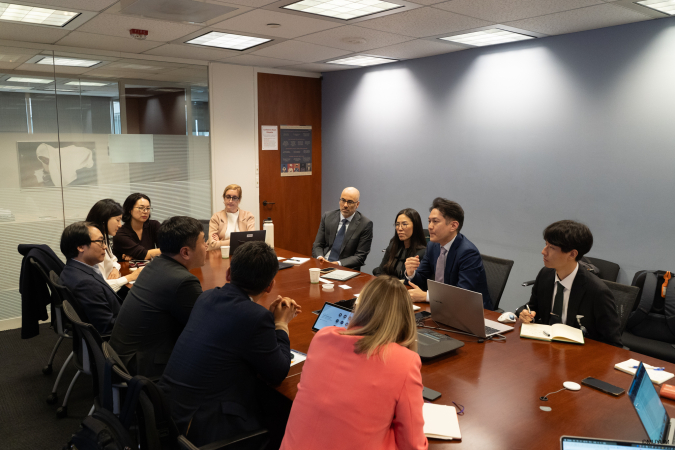
A kickoff workshop was held during the World Bank Annual Meetings earlier this month, with participation from Professors Kyung-Ryul Park and Seok-Kyun Woo (Graduate School of Science and Technology Policy), Dean Ji-Yong Eom (Graduate School of Green Growth and Sustainability), Researcher Seung-Hyun Kim, and Consultant Ji-Su Sim (M.S. Class of 2025, STP).
“This collaboration is not merely a technical project but an innovative effort to digitally connect youth employment and social protection systems,” said John Van Dyck, Director of the World Bank SPL Global Practice. “It will help East African governments design sustainable and inclusive digital labor infrastructures.”
Yoon Young Cho, Senior Economist at the World Bank, added, “The project seeks to digitalize social protection systems in East Africa to promote youth employment and social inclusion, focusing on building sustainable, government-led public digital solutions.”
Professor Kyung-Ryul Park of KAIST stated, “Through this partnership with the World Bank, we hope to support inclusive development in East Africa while offering KAIST researchers and students valuable opportunities to learn and grow through real-world international cooperation.”
#the World Bank #global center #partnership #AI #Big Data #development #strategy
Go to the original article
|
|
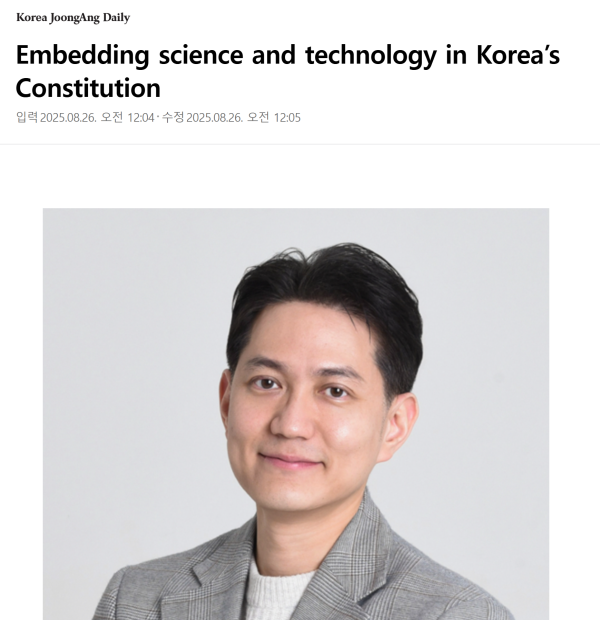
[Opinion] Embedding science and technology in Korea’s Constitution (Korea JoongAng Daily, August 26, 2025)
The Lee Jae Myung administration has placed constitutional reform as its top national policy goal. In Korean politics, constitutional debates have long centered on restructuring the political system, and today’s discussions remain similar. Yet revising the Constitution must go beyond altering power structures. Amending the 1987 Constitution, born nearly four decades ago, should serve as a forward-looking declaration that defines the nation’s governing philosophy for generations. Science and technology deserve to be central in this debate.
Lee Han-joo, chairman of the Presidential Commission on Policy Planning, delivers remarks at the commission’s closing ceremony at the annex of the government complex in Jongno District, central Seoul, on Aug. 14. The commission designated constitutional reform as its top policy priority. [YONHAP]
The current Constitution addresses science and technology only briefly. Article 127 states: “The State shall strive to develop the national economy by fostering innovation in science and technology, and the development of information and manpower.” This reflects the industrialization mindset of the high-growth era in the 1980s. Today, amid sweeping technological transformation, this provision no longer captures the full reality. Its shortcomings are clear.
First, the Constitution subordinates science and technology to economic growth. It treats them merely as tools of industrial development. Second, it neglects the universal values that science and technology represent — values tied to human life, freedom, creativity, rationality and constitutional rights. Third, it lacks a normative basis to guide the social responsibility of science and technology. While technological change accelerates exponentially, institutions and culture evolve more slowly. This creates imbalances between innovation and society, leading to ethical conflicts, human rights disputes and clashes between technology and fundamental rights.
For these reasons, a revised Constitution must redesign its treatment of science and technology. Three directions are particularly important.
The first is to elevate science and technology to the level of fundamental rights and core constitutional values. British scholar Jacob Bronowski, in “The Ascent of Man” (1973), described science as the essence of questioning authority and challenging convention. Science and technology should be recognized not only as instruments of progress, but also as values that all humanity must enjoy, manifestations of creativity itself. A modern Constitution should enshrine science and technology as principles that strengthen human dignity, freedom and creativity in a democratic republic.
Second, the Constitution must acknowledge and manage the dual nature of science and technology. Elevating their importance does not mean succumbing to technological determinism or blind faith in innovation. While science and technology drive growth, social development, and improved quality of life, the benefits are unevenly distributed. Artificial intelligence, for instance, exposes societies to new ethical risks. The Constitution should explicitly state the social responsibilities and public nature of science and technology, ensuring that innovation remains aligned with human dignity and fundamental rights.
Third, constitutional reform must reflect the interests of future generations. Mark Carney, the current prime minister of Canada and former governor of the Bank of England, spoke of the “tragedy of the horizon,” where long-term risks like climate change are shifted onto those unable to influence present-day decisions. Today’s constitutional framework ties science and technology too narrowly to short-term growth. A revised charter should guide innovation toward sustainability and safeguard the rights of generations yet to come.
The Constitution Association of Korea, an organization of former lawmakers, holds a roundtable discussion on constitutional reform with about 10 civic groups and academic societies at its office in Yeouido, western Seoul, on July 24. [CONSTITUTION ASSOCIATION OF KOREA]
Embedding science and technology in the Constitution would be more than a policy statement. It would be a pledge about the future Korea seeks and the responsibilities it accepts across generations and borders. In an era where humans and nonhumans coexist, such a constitutional vision would affirm Korea’s global responsibility. At its core, science is built on the assumption that “I might be wrong.” Knowledge remains open to testing and refutation, which has driven intellectual progress. Paradigm shifts arise from questioning established systems and recognizing that complex realities cannot be reduced to binary thinking.For these reasons, the more uncertain and polarized the world becomes, the more science and technology must serve as a foundation for public debate and rational thought. They should stand as one of the strongest principles underpinning a democratic republic. Writing these values into the Constitution would not only signal Korea’s maturity as a society but also provide a steady vision amid turbulence. By placing science and technology at the heart of constitutional reform, Korea can build a framework that fosters resilience and innovation for decades to come.This article was originally written in Korean and translated by a bilingual reporter with the help of generative AI tools. It was then edited by a native English-speaking editor. All AI-assisted translations are reviewed and refined by our newsroom.
Go to the original article
|